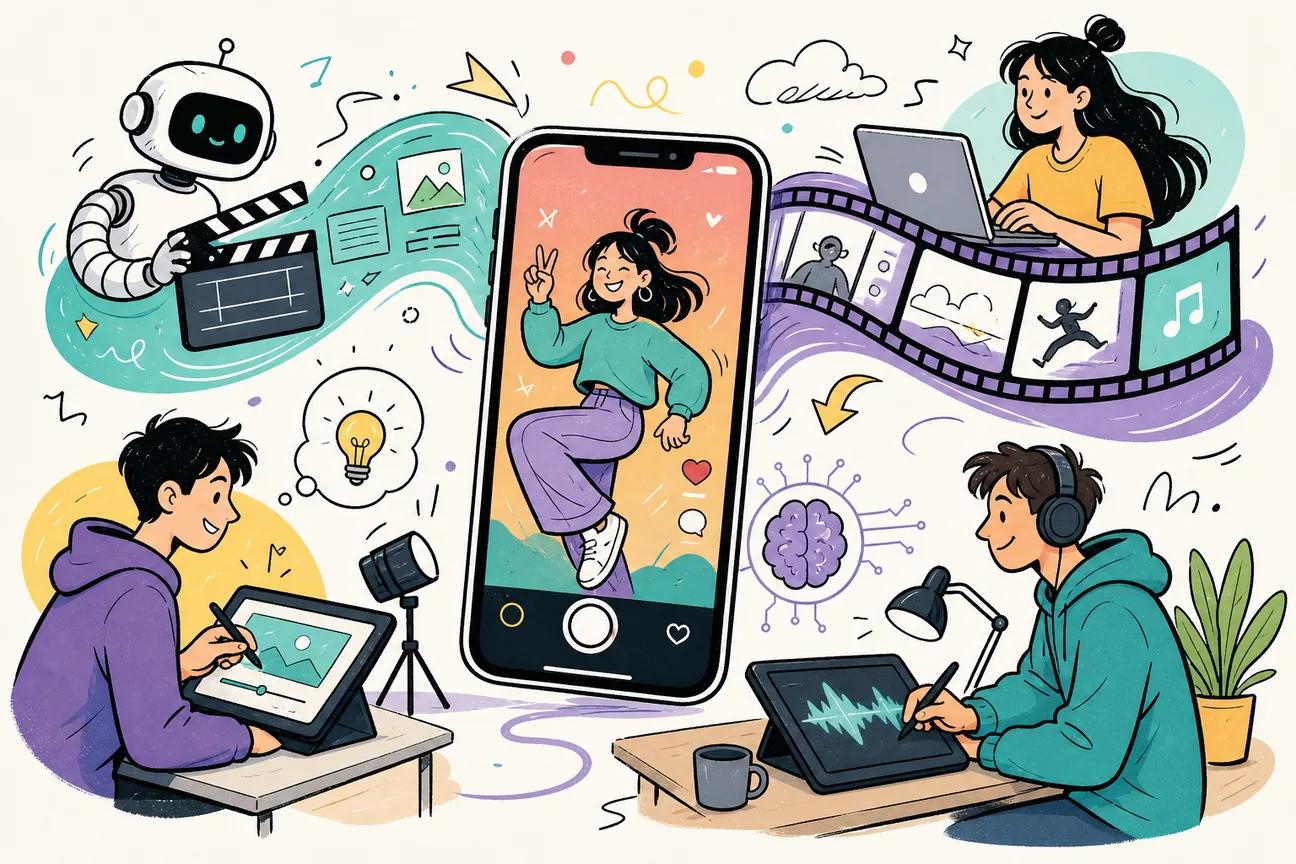
Short form video is the fastest-moving content format right now, and most creators lose ground not because they lack ideas but because they react to trends too slowly. AI video generation tools have cut production time from days to minutes, so the bottleneck has shifted from making videos to knowing which formats to chase and how to execute them before the moment passes. This guide walks you through a five-step process to spot trends early, read platform signals, produce AI-powered clips, export them correctly, and measure what actually works.
Step 1: Identify Emerging Short‑Form Formats
Your goal here is to build a live feed of what's gaining traction before it peaks. Waiting until a format is everywhere means you're already late.
Start by watching the For You Page on TikTok and the Reels Explore tab for 15 minutes a day. Don't just scroll passively. Note the first three seconds of every video that stops you. Write down the format: is it a myth-busting cut, a looping visual, a voiceover with kinetic captions, or a prompt-to-result reveal? These recurring structures are the formats worth cloning.
A few format types have shown consistent cross-platform durability. Voiceover-plus-kinetic-captions works on TikTok, Reels, and Shorts because it's hook-dense and visually readable without sound. The myth-and-truth cut ("Myth: X" then "Truth: the opposite") runs under ten seconds and works on all three platforms. Smooth loops under three seconds get a watch-time lift on both TikTok and Shorts because replays count as engagement. These formats survive cross-posting because they don't rely on platform-specific features.
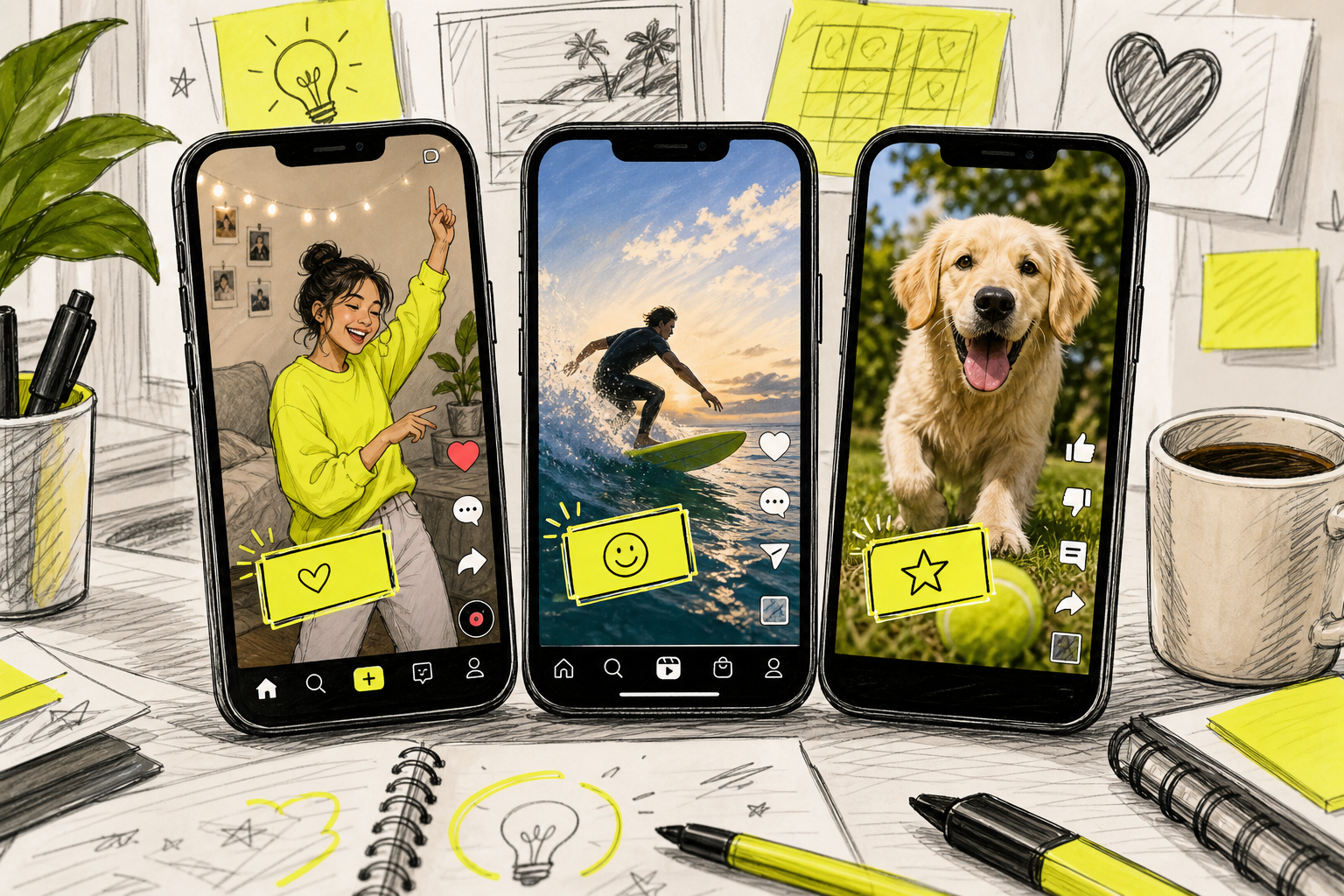
Beyond passive watching, use TikTok's search bar as a trend detector. Type a broad topic keyword and sort by "This week." The videos with the most shares relative to views are formats that people find worth sending to others. That share signal is a stronger indicator of a rising format than raw view count.
One usable habit: keep a shared doc or note where you log one new format per day. After a week, you'll have seven candidates. Test two or three per week. The ones that pull above-average completion rates in your first 48 hours are worth repeating. The rest you drop without guilt.
Platform length targets matter from the start. Research on short-form video performance shows YouTube Shorts peaks at 20 to 25 seconds for completion, Instagram Reels peaks at 60 to 90 seconds, and videos under 90 seconds retain about 50% of viewers on average. Build your format experiments around those windows, not arbitrary lengths.
Step 2: Analyze Platform Algorithm Signals
Each platform rewards different behavior, and treating them as the same product is the fastest way to waste good content.
TikTok's algorithm runs on an interest graph, not a follower graph. It tests every video against a small batch of users whose interests match the content's signals (audio used, hashtags, on-screen text, visual category). If completion rate and shares are strong in that batch, the video goes to a larger group. This means a zero-follower account can reach millions if the content connects. The trade-off is volatility: the same account can have a video hit two million views and the next one hit two hundred.
YouTube Shorts works differently. It factors in whether viewers click through to more of your content or subscribe after watching. A January 2026 algorithm update added search filters and popularity sorting for Shorts, which means titles and descriptions now carry real weight for discoverability. Educational and evergreen content benefits most from this, because it can accumulate views through search for weeks after posting.
Instagram Reels uses a hybrid model. It first shows content to a slice of your existing followers, then expands to non-followers through the Reels tab and Explore if engagement is strong. Meta's algorithm increasingly favors production polish, so the reach gap between high-quality and low-quality content widened through 2026. Reels are reshared 4.5 billion times daily through DMs, making peer recommendation a major distribution channel that pure algorithmic reach doesn't capture.
The usable read: if your content depends on trending sounds and fast cultural moments, TikTok distributes it faster. If it's educational or niche, YouTube Shorts gives you longer-tail discoverability. If you have an existing audience and strong visuals, Reels amplifies through shares. Pick your primary platform based on content type, not just where the audience is biggest.
One more signal worth watching: Google now surfaces short-form video in main search results. That means a well-titled YouTube Short on a searched topic can pull organic traffic from outside the platform entirely. Short-form is no longer just a social format. It's a search result type.
Step 3: Create AI‑Powered Video Content with Seedance Studio
Once you know which formats to chase and which platform to prioritize, production speed becomes the deciding factor. Trends have a short window. A format that's rising today can be oversaturated in 72 hours.
This is where AI video generation changes the game. We built Seedance Studio on Seedance 2.0, ByteDance Seed's flagship model, which is currently ranked number one for both text-to-video and image-to-video output. You type a prompt describing your shot, upload reference images or clips if you have them, and get back a finished video with camera direction, consistent characters, and native sound. No download required, no waitlist, and a free tier to start.
The usable workflow looks like this. First, write a tight prompt. Vague prompts produce vague videos. Instead of "a product on a table," write "close-up dolly shot of a skincare serum on a marble countertop, warm morning light, shallow depth of field." Name the camera move, the setting, and the lighting. Seedance 2.0 understands real cinematography language, so specificity pays off.
Second, attach references if you need character or scene consistency. Seedance Studio lets you tag up to 12 reference inputs per generation. For a multi-shot series, build a named element set before you start: one image per character, one establishing shot per location. Tag them by name in every prompt and the model keeps them consistent across clips.
Third, set your output format before you generate. Pick the aspect ratio for where the video will live: 9:16 for TikTok, Reels, and Shorts; 16:9 for YouTube standard. Generating at the right ratio from the start saves you the crop step later and avoids the safe-zone problems that come from resizing after the fact.
AI-generated content is now confirmed monetizable on YouTube and TikTok as long as the script, voice, and creative direction are original to you. That clarification removed a major gray area for creators building AI-first workflows. The caveat: YouTube has tightened its stance on low-effort AI content, so original direction and a real creative point of view still matter.
For creators who want to understand the model tiers before committing to a plan, the guide on Seedance 2.0 Mini vs Fast vs Standard breaks down when to use each tier so you're not burning flagship credits on draft iterations.
Step 4: Optimize for Cross‑Platform Rendering
Generating a great video and then posting the wrong file to the wrong platform is a common and avoidable mistake. Each platform has distinct UI overlays that cover parts of your frame, and a caption or CTA that reads clearly on one platform can sit directly under a button on another.
The baseline spec for TikTok, Instagram Reels, and YouTube Shorts is 9:16 vertical at 1080×1920 pixels. That's your master file. But the safe zones differ. On all three platforms, the bottom third and the right-hand column of a 9:16 frame are covered by UI elements: like buttons, share icons, caption bars, and profile info. Keep your hook text, your face, and any on-screen CTA in the upper two-thirds of the frame. That one rule clears all three platforms without designing three separate versions.
YouTube Shorts has a 60-second threshold worth knowing. A 61-second file lands in a different recommendation bucket than a 58-second file. If you can't get under 60 seconds, either tighten the edit or go genuinely long (three to five minutes). Don't accidentally land in the gap.
For Instagram Reels specifically, the grid preview crops your video to a 4:5 ratio. Key text near the very top or bottom of a 9:16 frame can get cut in the grid thumbnail. Either add a 4:5 safe area in your template or upload a separate 4:5 cover image. This is still underused by most AI creators and it's a real reach lever.
Caption placement is another common failure point. Burned-in captions at center-bottom on a 9:16 file cover Reels' caption UI and TikTok's description overlay. Keep burned-in captions in the middle third of the frame vertically. Better yet, use each platform's native captioning tool after you've exported the clean file, so you can adjust placement per platform.
One export habit that protects reach: never download from TikTok and re-upload to Reels or Shorts with the TikTok watermark visible. Always export the clean file from your source. Both Meta and YouTube throttle watermarked reposts. The AI commercial generator workflow covers how to set aspect ratio and export specs at generation time so the clean file is ready for every platform from the start.
Step 5: Measure Performance and Iterate
View count is the metric platforms push to the front of their dashboards. It's also the least useful number for improving your content. Videos with high view counts but low completion rates are losing your audience early, while videos with modest views and strong completion rates are working better.
The metrics that actually change your creative decisions are thumbstop rate, completion rate, and hold rate. Thumbstop rate is three-second views divided by impressions. Above 25% means your hook is stopping the scroll. Below 15% means the first second isn't landing. Completion rate should be 50% or above for videos under 30 seconds. Hold rate (views past 15 seconds divided by impressions) tells you whether you're keeping attention past the initial hook.

Engagement signals rank by strength. Saves are the strongest: the viewer plans to return. Shares are next: the viewer recommended it to someone else. Comments show active attention. Likes are the weakest signal, but not worthless. If you're optimizing for organic distribution, saves and shares matter most because they tell the algorithm the content delivered real value.
For connecting video to revenue, UTM parameters are non‑negotiable. Add them to every link connected to a video: bio link, pinned comment, story swipe‑up. Tag the source (TikTok, Instagram, YouTube), medium (organic_video), and campaign name. Without UTM tracking, traffic is often recorded as direct and attribution is lost. The setup takes about 15 minutes per campaign.
TikTok has the most transparent native analytics for creative performance. YouTube's second-by-second retention curve is the best tool for finding exactly where viewers drop off. Use the retention curve to identify the specific cut point where you're losing people, then fix that moment in your next version. That's the iteration loop: measure the drop, diagnose the cause, adjust the prompt or edit, and test again.
Build your own baselines from 30 days of account data before comparing against industry benchmarks. Benchmarks vary by niche and content type. Entertainment content scores higher thumbstop rates than B2B content even with equally strong creative. Your own 30-day average is the number to beat, not a generic industry figure.
Once you have a clear picture of what's working, use that data to brief your next generation. If a 22-second looping format consistently outperforms your 45-second voiceovers, that's your signal to produce more of the former. The right AI video app makes it fast enough to act on that signal the same day you see it, which is the real competitive edge in short-form content.
FAQ
What are the biggest short form video trends right now?
The formats gaining the most traction are smooth loops, myth-and-truth cuts, voiceover-with-kinetic-captions, and AI-generated prompt-to-result reveals. Platform-level, TikTok still drives the highest raw engagement lift while YouTube Shorts has become the strongest cross-pollination engine, converting Shorts viewers to long-form subscribers at an 8 to 12% rate. Social commerce through TikTok Shop is the clearest monetization trend with a concrete revenue path.
How long should a short form video be in 2026?
It depends on the platform. YouTube Shorts peaks at 20 to 25 seconds for completion rate. Instagram Reels consistently delivers highest engagement at 60 to 90 seconds. TikTok's sweet spot is roughly 28 seconds for most formats. Videos under 90 seconds retain about 50% of viewers on average across platforms. Match your length to the platform rather than picking one length for all three.
Can AI-generated videos be monetized on TikTok and YouTube?
Yes, with conditions. Both platforms confirmed that AI-generated content is monetizable as long as the script, voice, and creative direction are original to the creator. YouTube has separately tightened its stance on low-effort AI content, so original direction still matters. The gray area from earlier years is largely resolved, but producing content with no real creative input still risks demonetization.
What metrics should I track for short form video performance?
Track thumbstop rate (above 25% is strong), completion rate (aim for 50% or higher on videos under 30 seconds), and hold rate past 15 seconds. For revenue attribution, add UTM parameters to every link connected to your video. Without UTMs, organic video traffic defaults to "direct" in GA4 and you lose visibility into which videos drive actual conversions.
How do I optimize one video for TikTok, Reels, and Shorts at once?
Generate or shoot in 9:16 at 1080×1920, keep your subject and any text in the upper two-thirds of the frame, and export the clean file without watermarks. Then adjust captions and metadata per platform: TikTok rewards long keyword-heavy captions, Reels rewards short punchy captions with three hashtags, and Shorts rewards a clear title plus the #shorts tag. One file, three caption passes.
Conclusion
The gap between creators who ride short-form trends and those who miss them comes down to speed and process, not talent. Spot the format early, match it to the right platform length, generate the clip fast with a tool built for this workflow, export it clean, and let the retention data tell you what to repeat. If you want to cut production time to minutes instead of hours, start a free Seedance Studio account and run your first text-to-video generation today.