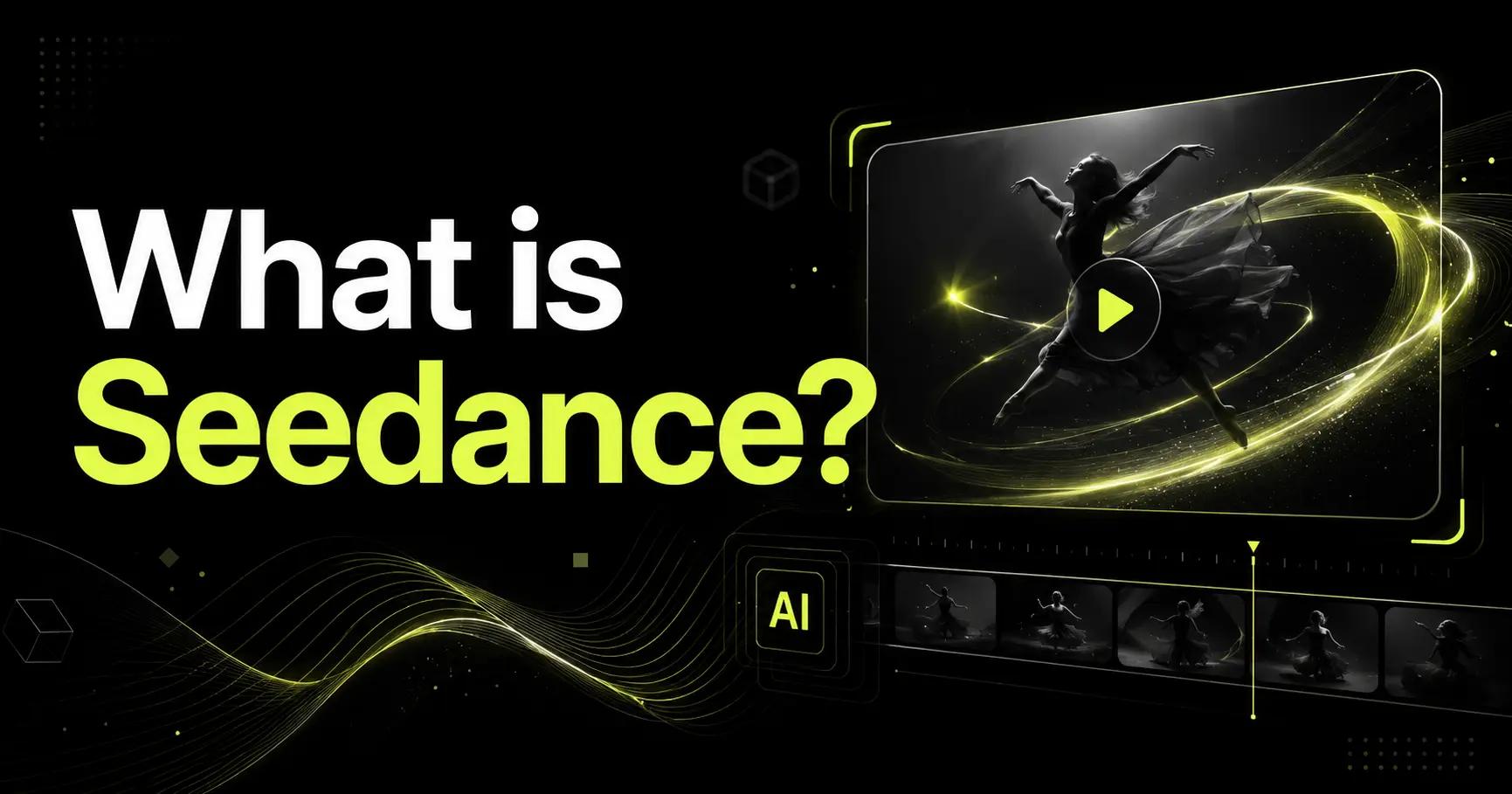
Seedance is a family of AI video generation models built by ByteDance Seed, the research group behind TikTok. The current flagship, Seedance 2.0, turns text prompts and images into finished video clips, with camera movement, consistent characters, and native sound and dialogue generated in the same pass as the picture. It currently ranks #1 for both text-to-video and image-to-video in the independent Artificial Analysis arena.
If you've seen a suspiciously well-shot clip on your feed lately (a product ad that no one filmed, an anime opening for someone's group chat), there's a decent chance Seedance made it.
This guide covers where Seedance came from, how it works, what makes it different from Sora, Veo, and Kling, what it costs, and how to try it yourself in about two minutes.
What is Seedance? The short answer
Seedance is an AI video generator developed by ByteDance Seed. You give it a text prompt, an image, or a mix of references, and it returns a short video, up to 15 seconds and up to 4K, with music, sound effects, and lip-synced dialogue already in. The latest model, Seedance 2.0, is available through several ByteDance surfaces (Doubao, Dreamina, Volcano Engine) and through Seedance Studio, which runs it in the browser with a simple prompt box and a free tier to start.
That's the definition. The rest of this post is the context.
Who makes Seedance?
The Seedance models are developed by ByteDance Seed, ByteDance's AI research division, part of the same company behind TikTok and CapCut. Seed builds a whole family of foundation models (language, speech, image), and Seedance is its video generation line.
ByteDance ships Seedance through its own products: Doubao and Jimeng (Dreamina) on the consumer side, and Volcano Engine and BytePlus for API access.
Seedance Studio is an independent app that gives you access to the Seedance 2.0 model through a prompt-based interface: no invite codes, no downloads, running entirely in the browser. We're not ByteDance; we're an independent studio built to make their model easy to actually use.
One question that comes up a lot: is Seedance open source? No. Seedance 2.0 is a proprietary model, available through hosted apps and APIs rather than as downloadable weights.
A short history of Seedance
Seedance has moved fast. Three model generations in about a year:
| Version | Released | What it added |
|---|---|---|
| Seedance 1.0 | Mid-2025 | First-generation release. Strong motion coherence for its time; clips in the 5–10 second range. |
| Seedance 1.5 Pro | 2025 | Incremental update: better motion, prompt-following, and audio quality. |
| Seedance 2.0 | February 2026 | The current flagship. A full multimodal rebuild: text, images, video, and audio in; synchronized video and stereo audio out, in one pass. |
| Seedance 2.5 | July 2026 | The next model: 30-second clips, up to 50 references, and frame-local editing. |
The jump from 1.x to 2.0 is the one that matters. Earlier versions generated video from a description. Seedance 2.0 reads everything you hand it: a prompt, a stack of reference images, a clip whose camera move you like, a music track. Then it plans a coherent scene around all of it.
What makes Seedance 2.0 different
Every AI video company claims to be the best. Here's what's concretely different about Seedance 2.0, based on how it actually works:
Multimodal references in a single prompt. You can attach up to 12 references per generation (9 images, 3 video clips, and 3 audio tracks) and tag them directly in the prompt: "@image1 walks through @video1's location wearing @image2's jacket." The model reads each reference's role and keeps it consistent, a depth of multi-reference control that's still rare among competing models.
Native sound, not post-added audio. Score, ambient effects, and character dialogue are generated with the picture, synced to the action. Put a line of speech in quotation marks and your character says it on screen, lip movement included. There's no separate audio step to bolt on afterward.
Multi-shot scene planning. Seedance 2.0 doesn't just render a single continuous take. It plans the cut (establishing shot, push-in, reaction) and keeps characters looking like themselves across every angle. That's the difference between a clip and a scene.
Benchmark standing. As of this writing, Seedance 2.0 ranks #1 for both text-to-video and image-to-video in the Artificial Analysis arena, a blind human-preference leaderboard that's independent of any model vendor. Leaderboards shift, so check the live rankings. Still, it's the fairest available comparison, and Seedance sits at the top of it.
What can you make with Seedance?
The honest answer is "short video of almost anything," but four use cases dominate:
AI video ads: Your product photo goes in as a reference; a finished product spot comes out. Teams that used to spend a quarter on a shoot now iterate in an afternoon.
Music videos: Upload the track as an audio reference and the visuals land on the beat, cuts included.
Short films: Multi-shot scenes, characters that stay consistent, and dialogue with real lip sync. Fifteen seconds is enough for a complete beat: setup, turn, payoff.
Social content: Vertical, square, or widescreen, sized for TikTok, Reels, and Shorts, and fast enough to post before the trend dies.
Is Seedance free?
Yes, to start. Seedance Studio's free plan includes a few videos a month at 480p (watermarked), with no card required. That's enough to see what the model does with your idea before you pay anything.
Paid plans start at $14/month and add more generations, higher resolution (up to 4K), watermark-free exports, and a commercial license. The full breakdown is on the pricing page.
How do I access Seedance?
Create a free account, and Seedance 2.0 is the default model in the prompt box: no waitlist, no invite code, nothing to download. It runs in the browser, so it works on any device, and it's available in the US and worldwide.
If you want the full walkthrough (prompt structure, references, aspect ratios, exporting), we've written a step-by-step guide to using Seedance 2.0.
Developers can also call the model programmatically through the Seedance API.
Seedance vs. Kling, Sora, and Veo
Seedance 2.0 competes in the same tier as Kling 3.0 (Kuaishou), Sora 2 (OpenAI), and Veo 3.1 (Google), and Kling is the comparison people search for most.
We won't pretend to referee that fight in three paragraphs; every vendor's marketing claims #1, which is exactly why independent, blind-preference benchmarks like Artificial Analysis are the fairest way to compare. What we can say concretely: Seedance's most-cited edges are its native audio generation (sound and dialogue in the same pass as the video) and its 12-reference multimodal input system, which gives it unusual control over consistency across shots.
The cheapest way to form your own opinion is to run the same prompt through each tool's free tier and watch the results side by side.
Seedance FAQ
What is Seedance?
Seedance is an AI video generator built on ByteDance's Seedance model family. It turns text prompts and images into short videos with native sound and dialogue. Seedance Studio runs the latest model, Seedance 2.0, which ranks #1 for text-to-video and image-to-video in the Artificial Analysis arena.
Who owns Seedance?
The underlying model is developed by ByteDance Seed, the AI research division of ByteDance, the company behind TikTok. Seedance Studio is an independent app that provides access to the model through a simple prompt-based interface.
Is Seedance free to use?
Yes. The free plan includes a few watermarked videos a month with no card required. Paid plans start at $14/month for more videos, higher resolution, and a commercial license.
Is Seedance available in the US?
Yes. Seedance Studio runs in the browser and is available in the United States and worldwide. You just need an account.
Is Seedance open source?
No. Seedance 2.0 is a proprietary ByteDance model, available through hosted apps and APIs rather than as open-source weights.
What's the difference between Seedance and Seedance 2.0?
Seedance is the model family; Seedance 2.0 is the current flagship version, released in February 2026. The earlier Seedance 1.5 Pro is still selectable in the studio's model picker, and Seedance 2.5 is next.
Does Seedance generate sound?
Yes. Stereo music, ambient sound effects, and character dialogue are generated in the same pass as the video and synced to the action. Quoted lines get matching lip movement.
Is Seedance safe to use?
Seedance is a hosted commercial model with built-in content moderation. The usual rules apply: don't use it to impersonate real, identifiable people without consent, and follow disclosure requirements for synthetic media wherever you publish.
Try Seedance 2.0 free
The fastest way to understand Seedance is to type a prompt and watch what comes back. The free plan gets you a few videos a month, enough to see what the #1-ranked model does with your idea.
Want to go deeper? Read how to use Seedance 2.0, learn which Seedance model to pick, or see what's coming in Seedance 2.5.